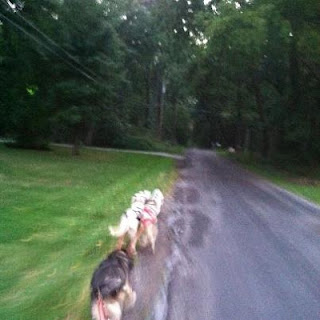
This is the first season ever in my seventh season of running dogs in Ohio that I've been able to start four-wheeler fall training in AUGUST! This is great because I still had the yearlings from Tak's litter last July to totally harness break (get used to learning their job as sled dogs).
In four short months we have to go from this...
Harness breaking puppies the other evening. Yearlings Perry and Tosh are in the middle there, with their papa, Yeti, taking up the wheel
...to this
My team on the beginning of the second leg of the Midnight Run last year.
We have many miles to get under our harnesses before our first race in January. I am super stoked for this season!
New members to the team this season are the yearlings from the Reggae Litter, who are now all officially harness broken, thanks to Mother Nature's cool temperatures earlier this week. I am in the process of selling some of my females in order to move from running almost primarily females to primarily males this season. Here are some of the boys.
Meet Perry, the biggest and so far the superstar of the Reggae litter. With six hook ups since last April, he's already rockin' in harness as if he's been running in the team for years and years. Perry is named after the Reggae dub great, Lee "Scratch" Perry.
Perry giving me his best "I'm sexy and I know it" look
Returning older yearling (who will be two in November) is rockstar, educational doggy, and the kennel's 2011/2012 MVP: Miles.
Miles, who, despite his intimidating and bulging muscles, is the sweetest and most patient education dog for my dog sledding presentations. He finished the Midnight Run as a yearling last February.
Perry's brother and Elise's sled dog (who she says I can race) is Tosh.
Tosh, who also masquerades as an arctic fox
Despite popular belief, Tosh is NOT named after Comedy Central's funny (and often unsavory) show, Tosh.0. He is one of the Reggae Litter, and was named after reggae master and original core member of Bob Marley and the Wailers, Peter Tosh. His name is fitting, too, because he is laid back as any Rastafarian.
Perry and Tosh's brother, Wailer, was a bit more challenging to capture a photo of, even for me. He does not stop moving! Here is Wailer...clearly named after Bob Marley and the Wailers. His name was apropos for him from birth, however, because he had the loudest mouth of all the Reggae litter!
Wailer
Here is the proud papa of the Reggae litter...cornerstone of my kennel and the most natural leader, Yeti.
Yeti
And, leading the pack, the dynamic duo...the sisterhood of the traveling fur pants.... leaders in crime, Ruffian and Big Brown.
Fall is really the most wonderful time of year. It bombards the senses with the colors, the smells, and the cool crisp morning air. I love fall!
Fall training in the Upper Peninsula outside Nature's Kennel in McMillan, Michigan is especially beautiful.
I recently returned from another trip up north for some training time with the amazing canine athletes I call Team Diamond Dogs. We have logged many miles toward conditioning goals so far this season, and are looking forward to the time when we head back up north.
My team of amazing canine athletes all muscled up on a training run. Oh, how I love and admire them!
See that dark dog up in front of my team? On the right in the photo above?
Here. This is a close up shot of him.
Look at those eyes. Such intelligent, expressive eyes.
These eyes belong to my main squeeze dogger, Yeti. He has been my main leader since he was 10 months old.
Today, Yeti turns four. This blog post is for Yeti, the backbone of my kennel and my main dude.
I wrote last winter about what it takes to be a lead dog. That post is here if you are interested in reading further.
Yeti began leading long strings of dogs almost as soon as he was in harness. There are several "types" or levels of lead dogs. At that time, Yeti was a natural trail leader - a dog who naturally is comfortable being out in front and getting a team down the trail. He or she doesn't necessarily know commands, but has a knack for leadership and command.
Then there are gee/haw leaders - dogs who mature into knowing commands and following a musher's directions down the trail. This involves high intelligence levels and a keen sense of direction. Gee, in mushing lingo, tells a dog to turn right; haw, subsequently, communicates a left hand turn. There are more commands, but for the purposes of this post, I will focus on these two simple commands.
Yeti has finally graduated into what I would technically call a "gee/haw" leader. He has logged hundreds of miles on the trail in his four short years - enough to confidently follow my commands, even on unfamiliar trails he's never been on before.
Finally, there are crack leaders - dogs who are like power steering to a musher. They will turn on a dime the second a command is called, without hesitation, even if it means driving into an area that looks like there's no trail. Their command and understanding of words is so precise and finely tuned, that some mushers recount tails of driving large teams of dogs through a slalom-type course with crack leaders.
In just a little over three short years in harness, Yeti has mastered many skills. He passes through large areas of standing water without pause, as is illustrated in the video below.
He's raced through crowds of strange people without hesitation. He's learned how to navigate felled logs and unfamiliar trails. And this past summer, he fathered his first litter of future athletes, and, hopefully, lead dogs.
I couldn't put a price on Yeti. He is such a special boy to me. And what's ironic is, he was given to me.
Indeed, Yeti is the best "free" dog I've ever gotten! Happy Birthday, Yeti!
A word about conditioning
Conditioning with the dogs is a lot like people training for a marathon. It takes months to build up the muscle, stamina and endurance needed to compete in races when the snow flies. The beginning part of the fall is spent primarily on muscle-building. We do this through training with a four wheeler.
There are varied training methods and theories. For me, I generally train my dogs in 2nd or 3rd gear on the four wheeler, allowing them to alternate between slower, harder-pulling training runs to faster, easier-pulling training runs. I may alternate between training slower and in gear on the quad one day to training with the quad completely off and in neutral the next and allowing the dogs to lope more to build up their speed.
Anyone who has ever been a runner knows this routine. And like runners training for a marathon, the dogs have their good days and not-so-good days.
Mostly, we have had great days lately. The mistakes made have primarily been made by me, not the dogs!
My little canine carnivores resting during a 10 mile training run. Yeti (left) and Ruffian (right, standing)
Stay tuned as we up the mileage heading into November!